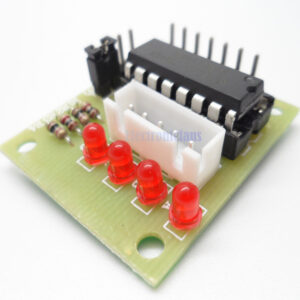



PhidgetStepper Bipolar HC
35.40 د.ك
The PhidgetStepper Bipolar HC is a high-current bipolar stepper motor controller designed for robotics systems, automation projects, CNC applications, Arduino projects, and embedded electronics development. It provides reliable control for bipolar stepper motors in motion-control systems.
In stock


Description
The 1067_0B is identical to the 1067_0, except that you have the option of whether you want to include the USB cable.
The 1067 – PhidgetStepper Bipolar HC allows you to control the position, velocity, and acceleration of one bipolar stepper motor. This is the product you want to use to control larger industrial steppers or for applications that need a lot of torque.
The 1067 can also be used in applications that require very precise positioning. It uses micro-stepping at all times to ensure smooth acceleration.
This board is USB isolated, protecting your system from ground loops, and comes with a built-in replacable ATP Blade Terminal fuse to protect against an over-current scenario.
The PhidgetStepper Bipolar HC is a powerful motor controller designed for bipolar stepper motors, robotics systems, automation projects, and embedded electronics applications. This controller helps users manage precise motor movement for advanced motion-control systems and industrial electronics projects.
Because stepper motor control is important in robotics and automation systems, the controller provides stable and accurate motor driving performance. In addition, the compact board design makes integration easier in prototype systems and embedded hardware.
Many students, makers, and engineers use this controller for CNC systems, robotics projects, and smart automation applications. You can also combine it with the <a href=”/product/arduino-uno-r3/”>Arduino UNO R3</a> for stepper motor control and testing projects.
Understanding This Stepper Motor Controller
This motor controller is designed to drive bipolar stepper motors with precise movement control. It manages motor stepping sequences and power delivery to help motors rotate accurately in motion-control applications.
The controller is commonly used in automation systems and robotics because it provides reliable operation for positioning and movement tasks. Furthermore, it supports embedded electronics projects that require controlled motor movement and repeatable positioning.
As a result, developers can create advanced motion systems with improved motor accuracy and stability.
Main Features
- Bipolar stepper motor controller
- High-current motor driving support
- Reliable motion control
- Compact controller design
- Suitable for robotics systems
- Ideal for automation projects
- Useful for CNC applications
- Easy microcontroller interfacing
- Beginner-friendly hardware
- Supports embedded electronics
- Compatible with motion-control systems
- Suitable for Arduino projects
Technical Specifications
- Product Type: Stepper motor controller
- Model: PhidgetStepper Bipolar HC
- Motor Type Support: Bipolar stepper motors
- Function: Precision motor control
- High-current motor driving capability
- Compact PCB design
- Suitable for embedded systems
- Reliable motion-control operation
- Designed for automation applications
Common Applications
This stepper motor controller supports many robotics and motion-control applications. For example, developers use it in CNC systems, automation projects, and robotic movement applications.
Common applications include:
- Robotics systems
- CNC machine control
- Automation systems
- Arduino motor projects
- Embedded electronics projects
- Motion-control applications
- Smart automation systems
- DIY electronics experiments
- Positioning systems
- STEM education projects
- Industrial electronics projects
- Stepper motor control systems
In addition, many users combine the controller with the <a href=”/product/jumper-wires/”>Jumper Wires Kit</a> for fast prototyping and motor testing.
Why Choose This Motor Controller?
This motor controller provides a simple and reliable way to control bipolar stepper motors in electronics systems. The compact design also makes installation easier in robotics hardware and embedded projects.
Users can build precise motion-control systems without complicated motor-driving circuits. Therefore, the controller is useful for students, makers, robotics developers, and automation engineers.
Another advantage is its compatibility with many microcontroller platforms and automation systems. Because of this, it works well in educational electronics, robotics projects, and industrial control applications.
Compatibility
Compatible with:
- Bipolar stepper motors
- Arduino UNO
- Arduino Nano
- ESP32 Development Board
- Embedded electronics platforms
- Robotics systems
- CNC systems
- Automation projects
- DIY electronics projects
- Educational electronics kits
The controller can also be combined with the <a href=”/product/breadboard-test-circuit-mb-102/”>Breadboard MB-102</a> and <a href=”/product/esp32-development-board/”>ESP32 Development Board</a> for advanced automation systems.
Tutorial Section
Getting started is simple and beginner-friendly. First, connect the bipolar stepper motor to the controller output terminals. After that, connect the controller to your microcontroller and upload motion-control code to begin motor operation.
For example, you can use this controller to:
- Build robotics systems
- Create CNC motion-control projects
- Develop automation systems
- Control precision motor movement
- Build positioning systems
- Create smart electronics applications
You can also combine the controller with the <a href=”/product/arduino-uno-r3/”>Arduino UNO R3</a> for motor testing and development projects.
Conclusion
The PhidgetStepper Bipolar HC is a reliable motor control solution for robotics systems, automation projects, CNC applications, and embedded electronics development. It provides accurate bipolar stepper motor control in a compact and easy-to-use design.
In addition, its stable operation, broad compatibility, and motion-control performance make it a practical choice for students, makers, engineers, and smart electronics developers.