
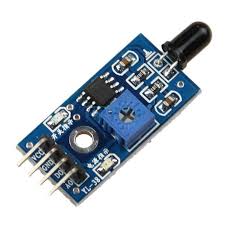
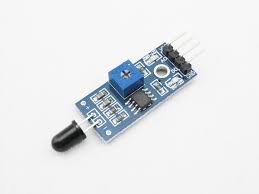
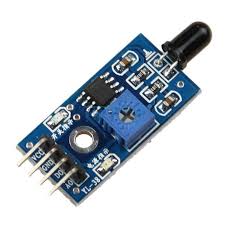
Flame sensor
1.00 د.ك
The Flame Sensor Module detects fire and infrared flame sources for Arduino, robotics, and alarm projects. Additionally, the module provides digital and analog outputs with adjustable sensitivity control.
In stock
Description
This sensor module is primarily used to detect an open flame. It does this by detecting light that is in the IR (infrared) spectrum which is emitted by a flame. That spectrum is typically in the range of 700-1100nm.
This module is similar to a regular IR detector, but with a broader detection range. It can be used as a general IR detector for other applications where a broad detection range is desired.
Outputs
The module has both an analog output and a digital output with sensitivity adjustment on the module.
The Analog output on ‘A0‘ is normally a voltage of approximately 1/2 Vcc when no signal is detected. The actual voltage level will depend on the setting of the sensitivity pot. If a flame is detected, that output voltage will drop towards ground depending on the strength of the IR detected.
The Digital output on ‘D0‘ is normally LOW. When IR is detected by the sensor, the output goes HIGH. The sensitivity adjustment can be used to set the trip point. LED2 will light when the output goes HIGH.
Flame Sensor Module for Arduino Fire Detection Projects
The Flame Sensor Module is a reliable fire detection sensor designed for Arduino, robotics, automation, and safety monitoring systems. In addition, the module can detect flames and infrared light emitted by fire sources using a high-sensitivity infrared receiver.
Moreover, the sensor provides both analog and digital output signals for flexible integration with Arduino and other microcontrollers. As a result, developers can create fire alarm systems, flame detection robots, smart safety devices, and automation projects more efficiently.
Furthermore, the onboard potentiometer allows users to adjust detection sensitivity according to environmental conditions. Therefore, the module is suitable for beginners, students, makers, and professional developers alike.
What Is a Flame Sensor Module?
A flame sensor module is an electronic device capable of detecting infrared radiation emitted by flames and fire sources. Additionally, the sensor identifies fire by measuring infrared wavelengths generated during combustion.
At the same time, the module provides fast response times and stable signal output for reliable fire detection. Because of this, flame sensors are widely used in alarm systems, firefighting robots, industrial safety systems, and smart automation projects.
Likewise, the module integrates easily with Arduino and embedded electronics systems through analog and digital output pins. Consequently, fire detection projects become significantly easier to develop.
Key Features
- Flame and fire detection support
- Infrared flame sensing technology
- Analog and digital outputs
- Adjustable sensitivity control
- Fast response performance
- Compact and lightweight design
- Suitable for Arduino projects
- Low power consumption
- Beginner-friendly integration
- Reliable fire detection performance
Additionally, the module supports real-time flame monitoring for automation and safety applications.
Technical Specifications
- Sensor Type: Infrared flame sensor
- Detection Method: Infrared light sensing
- Operating Voltage: 3.3V – 5V
- Output Type: Analog and digital output
- Sensitivity Adjustment: Supported
- Detection Angle: Approximately 60°
- Comparator Chip: LM393
- Application Type: Fire and flame detection
Overall, these specifications make the module highly suitable for fire monitoring and safety systems.
Fire Detection Applications
This flame sensor module is widely used in projects that require fast fire and flame detection. In addition, the adjustable sensitivity improves detection flexibility in different environments.
Furthermore, the module performs efficiently in alarm and automation systems. Therefore, users can create smart fire alarms, firefighting robots, and industrial monitoring systems more effectively.
At the same time, the analog output allows real-time flame intensity monitoring through Arduino and IoT systems. As a result, the module works exceptionally well in embedded safety electronics projects.
Why Choose This Arduino Flame Sensor?
This Arduino-compatible flame sensor combines reliable fire detection, adjustable sensitivity, and easy integration in one compact solution. In addition, the dual analog and digital outputs improve project flexibility for different applications.
Furthermore, the module supports direct connection to Arduino digital and analog input pins without complicated communication protocols. Therefore, beginners can quickly start building flame detection and alarm systems.
Most importantly, flame sensor modules remain highly popular in Arduino robotics and automation projects. Consequently, users can easily find tutorials, sample codes, and project examples online.
Applications
This module is suitable for many electronics projects, including:
- Arduino fire alarm systems
- Flame detection robots
- Smart safety systems
- Industrial monitoring
- Robotics projects
- DIY electronics
- Embedded systems
- Automation projects
- Educational engineering projects
- IoT safety monitoring systems
Additionally, the module is commonly used in robotics learning and safety automation systems.
Compatible With
- Arduino UNO
- Arduino Mega
- Arduino Nano
- ESP32
- ESP8266
- Raspberry Pi
- Alarm systems
- Relay modules
- Embedded electronics systems
- IoT development platforms
Furthermore, the module works seamlessly with many Arduino-compatible sensors and accessories.
Tutorial
The Flame Sensor Module can be connected directly to Arduino analog and digital input pins for fire detection applications. Additionally, users can trigger alarms, buzzers, LEDs, and relays whenever flames are detected using Arduino IDE programming.
Moreover, many tutorials and open-source examples are available online for beginners and advanced developers alike. Therefore, users can quickly build flame detection and fire alarm systems.
In conclusion, the Flame Sensor Module is an excellent choice for anyone looking for a reliable, beginner-friendly, and affordable fire detection solution for Arduino and automation projects.
Module Connections
There is a 4-pin header on the assembly.
- GND = Ground
- ‘+’ = Vcc (3.3 – 5V)
- A0 = Analog output, connects to analog input on uC
- D0 = Digital output, connects to digital input on uC